
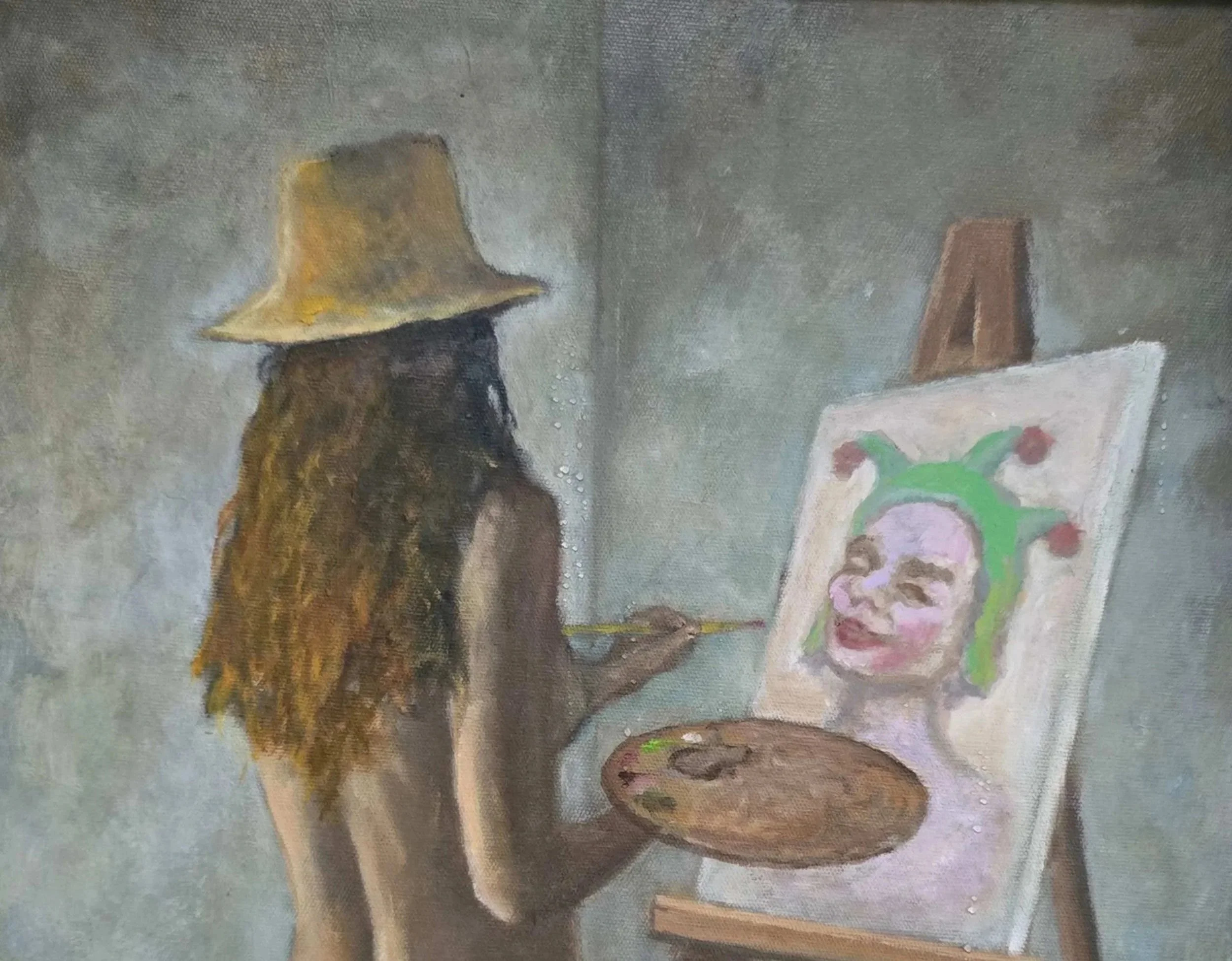
Beauty and The Fool
Eugene de Leastar
In Dostoevsky’s novel ‘The Idiot’, a remarkable claim is attributed to the hero, the innocent and naive Prince Myshkin that… Beauty will save the World.
This strange idea was in my mind some time ago while working in the old fishing town of Chioggia, south of Venice. I was accompanied by an Armenian girl to visit the home of a famous seafarer. For this sailor, ‘the captain’, had indeed circumnavigated the world. He was now, even at eighty, an impressive figure with the wily air of an Odysseus. His eyes grew large as he surveyed the Armenian, for she was quite striking with a torrent of black hair, more like a Medusa than a Magdalena. She seemed to have escaped from a Homeric world.
We sat in his living room, dark like a ship’s cabin, exchanging pleasantries when suddenly the captain turned and lifted a small guitar hanging on the wall behind, and began to serenade the Armenian with an old song from his birthplace, Genoa.
A barely perceptible smile passed her lips; she was well used to this ritual. The Armenian goddess is called Anahit but the Greeks know her as Aphrodite.
Prince Myshkin, so often called ‘a fool’ in the novel, suffered from a form of epilepsy (as did Dostoevsky). Before these devastating attacks, he seemed to briefly experience an acute sense of awareness, a momentary euphoria as though he was a witness to the ultimate nature of things; to truth itself.
Something of that perception now hit me in the fading light as the captain sang and tapped with his fingers on the guitar, giving rhythm to his wooing. Although this was a classical reversal, for here the sailor was seducing the siren.
A break in the clouds allowed a ray of light come through one of the windows and it illuminated the Armenian’s face. In that moment I was struck by the brutal and disturbing power that the poets call ‘beauty’. This thing that causes a blind primordial desire, deep in nature to sing, to praise, to recreate itself. Was this the beauty that will save the world? It seemed to me that it might just as well destroy it.
In the words of Sophia Proneikos; ’it was Eros that dragged Paris toward Helen and set Troy on fire for ten endless years, proving that civilizations often collapse not because of hatred but because of beauty’.
Some months later walking alone on a side street in Prague, the city of Kafka and his dark absurdism, I saw an old woman walking unsteadily towards me. She wore a good quality wine coloured coat. In her right hand she carried a small plastic bag of shopping. In her other hand, she was using a walking stick to navigate the paving stones.
When two people pass on a footpath they make allowances, sometimes unconscious, for each other, but not in her case. Her concentration on walking was resolute. She dared not look up, she had fallen before.
It was obvious also that she lived alone; no-one would have allowed her outside with the dark henna dye clinging to her scalp and staining her forehead.
As she passed I could tell from the fine symmetry of her lined now sunken face that she had once been a beauty. But this beauty did not save her.
Kafka wrote;
Youth is happy because it has the capacity to see beauty. Anyone who has the capacity to see beauty never grows old… I can attest that in this opinion he was mistaken.
Does beauty engender love? It depends on the type of love. If it is Eros then Kafka is right to describe that charnel house of emotion is as the knife that I turn inside myself.
But here is another love besides Eros, it is called Agape. This is the divine and unconditional love once championed by a middle eastern preacher, although he was considered insane by his detractors, even then (John 10.20). It is now out of favour in the west.
Those that follow Agape are rare like the hapless prince Myshkin, yet the fools for Eros are legion.
My heart went out to the lady of Prague, but what was I to do? Embrace her and make a fool of myself, perhaps frighten her to death and end up in prison?
Later I thought about the apocryphal story of concerning Nietzsche. When he witnessed a wretched coach horse, too worn out to continue, being flogged on a street in Turin. He flung his arms around the horse’s neck and wept. Yet soon he was to go completely mad.
There is a secret relationship between beauty and truth. Philosophers and artists pretend to know this but it is beyond them in the deep realm of the sacred. It is something only God knows and perhaps the occasional fool.
Chioggia 2026